Standardized Extracts and Botanical Powders Overview
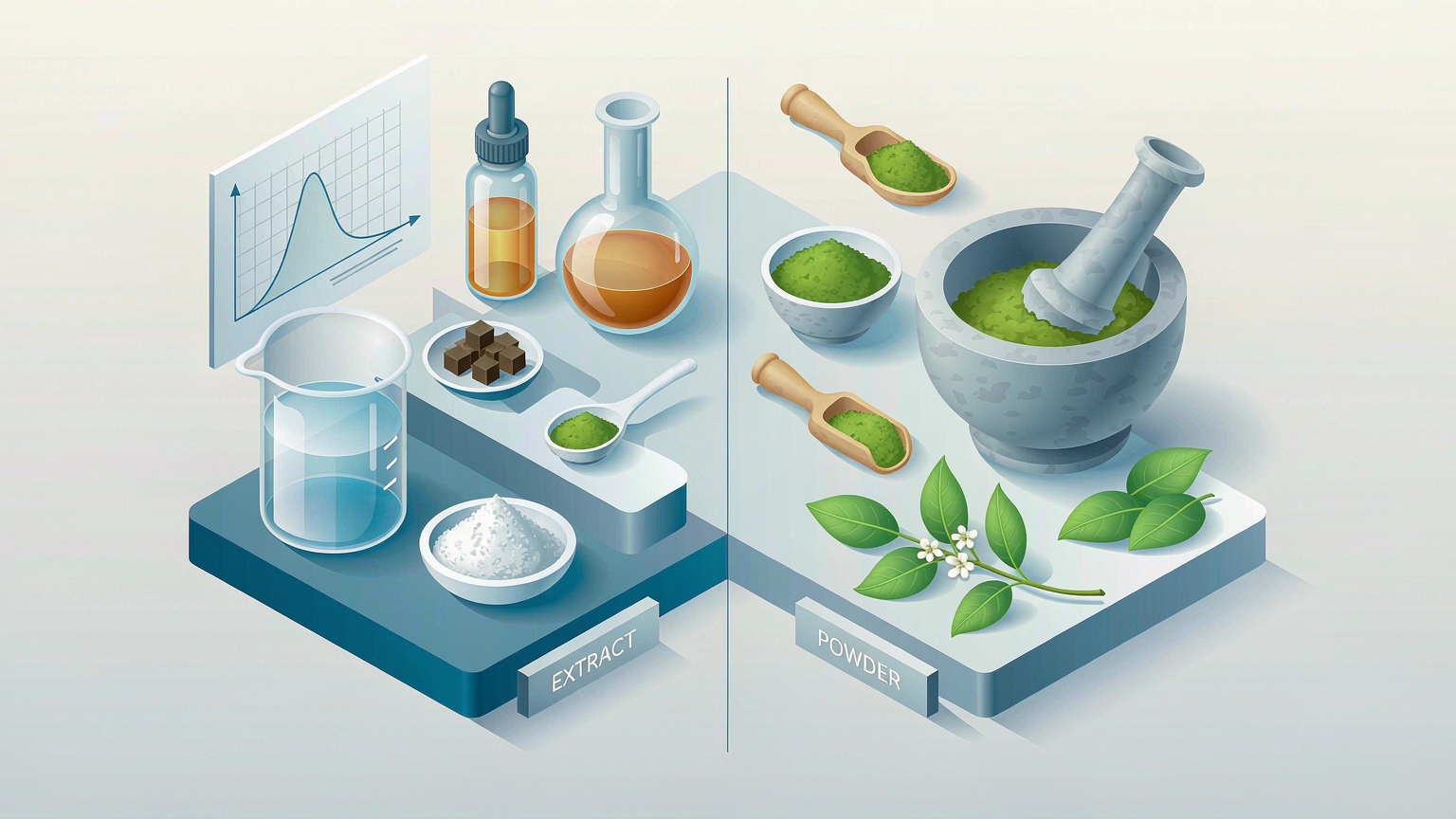
A botanical powder is generally a dried and milled plant material, while a standardized extract is usually defined by one or more measured markers or quality characteristics. Neither format is automatically better. The appropriate choice depends on the target formula, desired concentration, sensory profile, process, documentation, supply model, and final product category.
For a US B2B buyer, the useful comparison is not “extract versus powder” in the abstract. It is whether the specific product can meet the application specification with a repeatable test method, suitable packaging, clear intended use, and documentation that supports the customer’s quality review.
Key Takeaways
- Compare the plant identity and plant part before comparing concentration.
- Ask whether a value is a marker range, typical result, or release requirement.
- Review physical properties because powders and extracts can behave differently in a formula.
- Check sample-to-bulk continuity, batch records, packaging, storage, and change control.
- Do not interpret standardization as a finished-product performance statement.
1. What Is a Botanical Powder?
A botanical powder is typically dried plant material that has been milled. It may be made from a leaf, root, bark, seed, fruit, flower, mushroom body, or another defined plant part. The material may retain a broader plant matrix, including naturally occurring fibers, carbohydrates, proteins, minerals, and other compounds.
The actual composition depends on plant identity, harvest conditions, drying, milling, storage, and quality controls. A powder specification should identify the botanical material, plant part, moisture, particle size when relevant, microbiological limits, contaminants, packaging, and storage.
Powders may fit formulas built around whole-plant positioning, recognizable ingredient stories, specific sensory characteristics, or a particular cost model. They may also require a larger inclusion amount to provide the desired amount of a marker or functional component.
2. What Is a Standardized Plant Extract?
A standardized extract is usually defined by a measurable marker or group of characteristics. The specification may state a marker range, an extract ratio, a purity range, or another controlled attribute. The buyer should ask how the value is measured and whether it is a minimum, typical value, target, or release limit.
Standardization can make batch comparison easier, but it does not control every compound in the plant and does not establish a health or clinical outcome. A standardized extract still needs identity, contaminant, storage, packaging, and intended-use review.
3. Compare Identity and Plant Part First
Two products with the same common name may not be interchangeable if they use different species, plant parts, grades, or processing methods. For example, a root extract and a leaf extract can have different composition and application behavior.
Before reviewing price, compare:
The product name should be consistent across the quotation, sample, specification, COA, packaging, invoice, and purchase order.
4. Compare Marker Compounds Correctly
For a standardized extract, review the marker compound, units, target range, test method, sample basis, and batch result. For a powder, ask whether marker testing is available and whether the product is controlled through identity, moisture, microbiology, contaminants, or another specification.
Do not compare a marker value from an extract with a general powder statement as if the two results used the same basis. Ask the supplier to explain the units, method, dry or as-is basis, and applicable batch.
A marker is a quality or identity field. It should not be used to imply that the finished formula will deliver a particular health result.
5. Compare Processing and Concentration
Extraction can change the concentration, solubility, color, taste, odor, and physical behavior of a botanical. Review extraction ratio, solvent system, drying method, carrier, and any process aids that are relevant to the customer’s quality program.
Concentration alone is not enough to select a format. A higher concentration may change flavor, color, processing behavior, or cost. A lower concentration may fit a product that requires a broader plant matrix or a larger physical inclusion.
6. Compare Formulation Fit
| Formulation question | Why it matters |
| Is the material water-dispersible? | Important for beverages and liquid systems |
| Does it have a strong color or odor? | Can affect finished-product appearance and sensory profile |
| Is it hygroscopic? | May affect packaging and warehouse handling |
| What is the particle size? | Can affect flow, mixing, and mouthfeel |
| Is it heat or pH sensitive? | May affect processing and stability |
| What is the bulk density? | Can affect fill weight and equipment settings |
| Does it contain a carrier? | Can affect label and formulation calculations |
For capsules, density, flow, concentration, and fill weight may be important. For beverages, dispersibility, taste, color, and stability may be central. For cosmetics, solubility, color, odor, skin-contact requirements, and documentation may influence the choice.
7. Compare Documentation and Supply Requirements
Request the current specification, representative COA, test methods, storage, packaging, shelf life, sample information, allergen statement, origin information, and traceability details. Confirm that the results apply to the supplied product code and grade.
Also discuss minimum order quantity, sample-to-bulk continuity, lead-time assumptions, packaging format, shipping conditions, and change-notification practices. A product that looks suitable in the laboratory may create procurement risk if the sample grade cannot be supplied consistently.
8. Use a Selection Decision Tree
Use the following sequence before selecting a format:
- What is the final product category?
- Which plant identity and plant part are required?
- Is a marker compound required?
- Is the marker a release requirement or a target value?
- Does the formula need a powder or extract format?
- What physical properties are necessary?
- What quality documents are required?
- What batch and packaging conditions are acceptable?
- Can the supplier maintain sample-to-bulk continuity?
- Which claims and label statements require review?
9. Avoid Unqualified Performance Conclusions
A higher marker concentration does not automatically mean a better finished product. A lower concentration does not automatically mean a lower-value ingredient. A powder is not automatically less refined, and an extract is not automatically more effective.
The right decision depends on the target formula, dose, processing, label, sensory profile, documentation, cost, and supply plan. Procurement, formulation, quality, and regulatory stakeholders should review the choice together when the application is sensitive.
9. Avoid Unqualified Performance Conclusions
A higher marker concentration does not automatically mean a better finished product. A lower concentration does not automatically mean a lower-value ingredient. A powder is not automatically less refined, and an extract is not automatically more effective.
The selection should be made with procurement, formulation, quality, and regulatory input. Where the intended use is sensitive, the product category and claims should be reviewed before a specification is finalized.
10. Compare the Total Project Cost
The quoted price per kilogram is only one part of the decision. A buyer should also consider inclusion rate, required batch size, processing loss, packaging, testing, storage, shipping, and the cost of adjusting the formula when a material does not perform as expected. An extract with a higher price may require less material, while a powder with a lower price may require more space or additional processing.
The commercial review should also consider continuity. Ask whether the same grade can be supplied after the sample stage, whether the supplier can support the expected volume, how changes are notified, and whether the document package will remain current. A low initial quote does not compensate for an unclear specification or inconsistent supply plan.
11. Build a Supplier Comparison Record
When comparing two formats or two suppliers, use the same questions for both. Record product identity, plant part, processing, marker, test method, physical properties, documents, packaging, storage, sample result, minimum order, lead-time assumptions, and open questions. This makes the final choice easier to explain to procurement, formulation, and quality teams.
Do not rank suppliers using a single headline such as purity, concentration, or price. A suitable ingredient is the one that meets the project’s complete specification and can be documented for the intended product and market.
Common Questions
Is a standardized extract always more concentrated than a botanical powder?
Not necessarily. The terms describe different product definitions and processing approaches. Compare the actual specification, marker results, test method, and basis of measurement.
Can a botanical powder replace an extract in the same formula?
Not automatically. The replacement may change concentration, fill weight, flavor, color, flow, solubility, and the finished product specification. A formulation review and sample evaluation are appropriate.
Which format is easier to standardize between batches?
A standardized extract may provide a defined marker range, while a powder may use identity, moisture, microbiology, and contaminant requirements. The answer depends on the product specification and release process.
What should buyers request before comparing suppliers?
Request botanical identity, plant part, processing description, specification, COA, test methods, storage, packaging, sample information, and relevant quality documents.
Does standardization establish a health benefit?
No. Standardization describes a product-quality characteristic. It does not establish a disease, medical, or finished-product performance conclusion.
How should buyers compare two products with the same common name?
Compare botanical identity, plant part, extraction or drying process, marker method, product code, carrier, testing, storage, and intended-use documentation.
Does a powder always have a lower cost per finished dose?
Not necessarily. Cost depends on concentration, inclusion rate, processing, packaging, testing, waste, formula design, and supply volume. Compare the cost within the finished product specification.
Can the same ingredient be used in food, supplements, and cosmetics?
The answer depends on product category, intended use, specification, labeling, documentation, and target-market review. Do not carry an application statement across categories without confirmation.
Compare Botanical Ingredient Formats
Share the intended product format, target application, marker requirements, documentation needs, expected volume, and target market before comparing a powder and an extract.