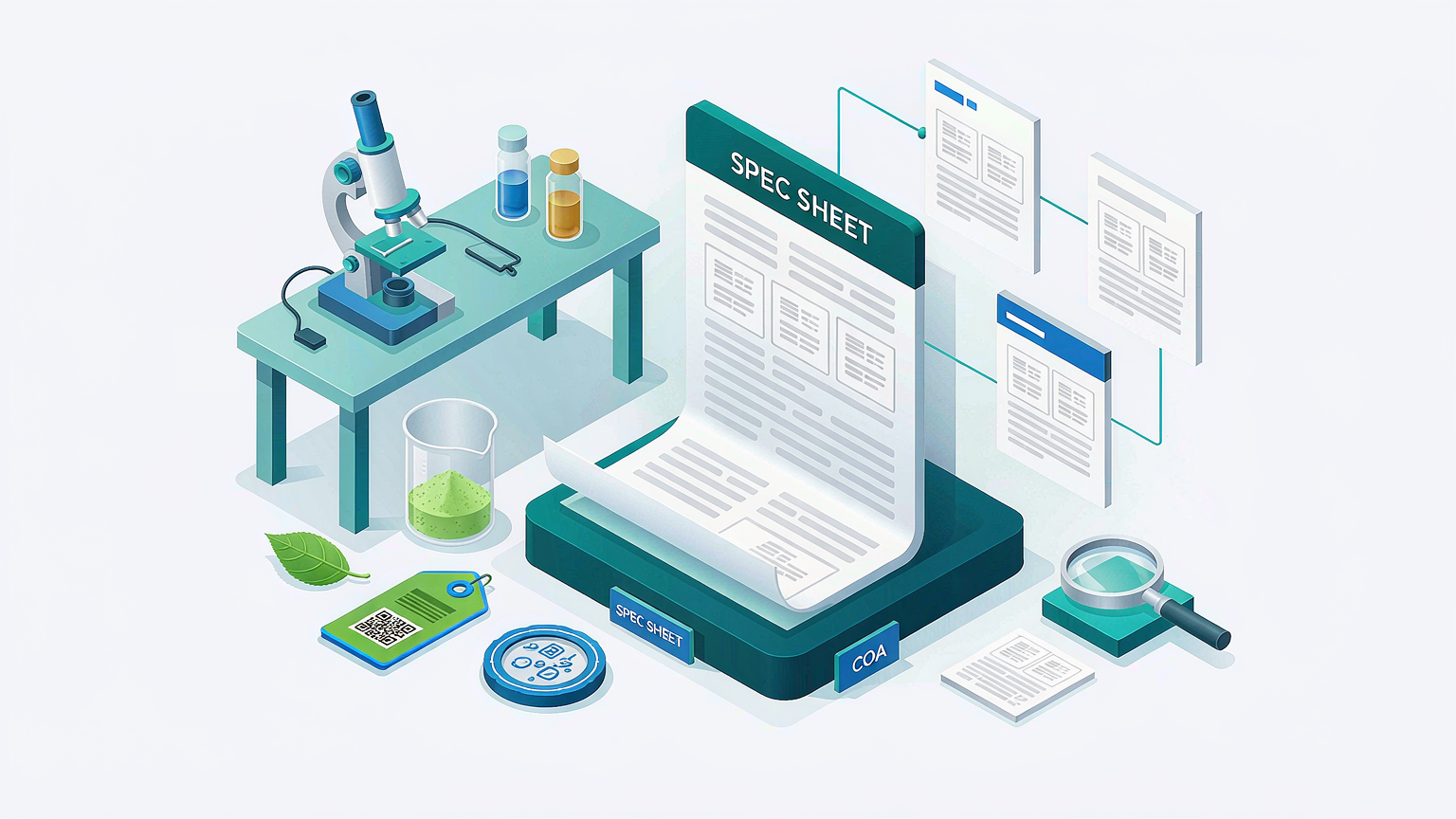
Botanical Extract Specification Sheet Overview
A botanical extract specification sheet is a technical summary of a raw material. It should help a buyer answer five questions: What exactly is the material? How was it processed? Which characteristics are controlled? How is each batch tested? Can the documentation support the proposed application? The sheet is most useful when it matches the product code, current version, batch COA, packaging, and intended market.
For a US B2B buyer, the review should connect procurement, formulation, quality, and regulatory teams. A higher marker value is not automatically a better ingredient, and a specification sheet does not by itself establish a finished-product claim. The purpose of the review is to confirm identity, consistency, suitability, and documentation.
Key Takeaways
- Confirm botanical identity and plant part before comparing price or concentration.
- Separate a specification or target value from a batch-specific COA result.
- Ask for the test method, units, acceptance range, document version, and release status.
- Review contaminants, packaging, storage, shelf life, and traceability together.
- Match the material to the final product category and intended application.
1. What a Specification Sheet Does
A specification sheet describes the expected characteristics of a product. Depending on the ingredient, it may include botanical identity, appearance, odor, moisture, marker compounds, extract ratio, microbiological limits, heavy-metal limits, residual solvents, particle size, storage, packaging, and shelf life.
It is not the same as a COA. A specification normally describes the requirement or target. A COA records the result for a defined batch or lot. A technical data sheet may provide additional application information, while an SDS focuses on hazard communication and handling. Buyers should keep these documents separate and connect them through the product code and revision number.
2. Start With Botanical Identity
The first review field should be the botanical identity. Check the accepted botanical name, common name, plant part, plant material, origin information when available, and product code. A leaf extract, root extract, bark extract, seed extract, fruit extract, and mushroom-body powder are not interchangeable simply because they share a common name.
Ask whether the product is an extract, whole botanical powder, granulated material, blended ingredient, or carrier-based preparation. If a trade name appears on the sheet, request the underlying material identity and the document that defines the trade name.
The name should match across the quotation, sample label, specification, COA, packaging, invoice, and purchase record. Differences such as “green tea extract,” “decaffeinated green tea,” and “tea polyphenol powder” may represent different products or different commercial descriptions. Resolve the difference before sample approval.
3. Review Plant Part and Processing Method
Plant part can affect the chemical profile, sensory properties, color, solubility, and application fit. The drying and extraction process can also influence the final material. A useful review asks whether the sheet states the extraction method, solvent system, extract ratio, carrier, drying method, and any processing aids that are relevant to the product.
The level of detail required depends on the project. A standard bulk ingredient may need a different technical package than a branded finished formula. A cosmetic ingredient may need different supporting information from a food ingredient. The buyer should define the required detail before supplier qualification.
4. Understand Extract Ratio and Standardization
An extract ratio describes a relationship between starting plant material and extract output under a defined process. It should not be treated as a direct measure of finished-product performance. Ask how the ratio is calculated, whether it is a typical or controlled value, and whether it applies to the current product version.
Standardization usually refers to control of one or more measurable markers or characteristics. Review the marker name, target range, units, test method, sample basis, and batch result. Also ask whether the marker is a release specification or an informational value.
For example, a product may be described as standardized to a certain polyphenol, catechin, flavonoid, or other marker. The presence of a marker does not automatically establish a health claim. It helps define product identity and consistency for a particular procurement or formulation purpose.
5. Check Purity and Contaminant Controls
Depending on the botanical and application, a buyer may request moisture, ash, residual solvents, microbiological limits, heavy metals, pesticides, aflatoxins, allergens, foreign matter, or other tests. The relevant list depends on the raw material, production process, customer specification, and target market.
Do not assume a short specification means every possible contaminant has been tested. Ask which tests are routine, which tests are performed per batch, which methods are used, which limits control release, and whether results are linked to the supplied batch.
For a US project, the final testing package should be reviewed against the proposed product category, label, customer quality system, and current market requirements. A supplier document supports that review but does not replace the buyer’s own approval process.
6. Connect the Specification to the COA
The specification and COA should be read together. Compare the following fields:
| Review field | What to confirm |
| Product name | Same commercial and technical identity |
| Product code | Same grade and format |
| Batch or lot | Specific material being released |
| Manufacturing date | Current and traceable date |
| Test date | Timing of the result |
| Test method | Method and reporting basis |
| Specification limit | Pass/fail requirement |
| Actual result | Batch-specific value |
| Release status | Approval or quality sign-off |
| Revision | Current document version |
If the specification says “standardized to” a marker range but the COA does not show that marker, ask how release is managed. If the COA includes a result that does not appear in the specification, ask whether it is routine, optional, or customer-specific. Keep the reviewed version with the supplier-qualification record.
7. Review Physical Properties and Formulation Fit
Physical properties can determine whether an ingredient works in a capsule, tablet, beverage, gummy, sachet, premix, or cosmetic system. Review color, odor, taste, particle size, flow, bulk density, moisture sensitivity, dispersibility, solubility, heat sensitivity, and pH sensitivity when relevant.
A powder that performs well in a capsule may not disperse well in a beverage. A strongly colored botanical may affect a finished formula even when its analytical specification is acceptable. A hygroscopic material may require special packaging and warehouse controls. Ask for the test condition instead of relying on a general word such as “soluble” or “stable.”
8. Review Packaging, Storage, and Shelf Life
Storage information should match the packaging and supply format. Review temperature, humidity, light protection, container type, shipping conditions, retest date, shelf-life basis, and opening instructions when available.
For powders and sensitive extracts, ask how moisture exposure is managed during filling, storage, and transport. For a finished formulation, compatibility and stability work may be separate from the raw material specification. The raw material document can guide the plan but cannot predict the finished product’s shelf life on its own.
9. Review Batch-to-Batch Consistency
A single COA can support an initial review, but supplier qualification should also consider how the supplier manages future batches. Ask about batch release, change notification, retained samples, deviation handling, traceability, complaint handling, and document revision control.
When a marker compound is important, compare more than one approved batch if the project allows. Look for the difference between a stated range and actual results. A narrow result range may be useful, but the test method and sampling basis still matter.
10. US B2B Buyer Documentation Checklist
Before approval, request and organize:
The package should identify the product code, version, intended use, target market, and review date. If a document is unavailable, record the gap as a question instead of filling it with a general claim.
11. US Buyer Approval Workflow
Use a staged review rather than approving a botanical extract from one document. First confirm identity and intended use. Then review the specification, representative COA, test methods, contaminant controls, packaging, storage, and sample. After the technical review, record open questions and assign them to procurement, formulation, quality, or regulatory owners. This creates a traceable decision instead of relying on a single sales conversation.
For repeat supply, define what triggers a re-review. Examples include a new product code, specification revision, plant-part change, extraction-process change, facility change, packaging change, certificate renewal, or a new intended use. A simple re-review rule protects the active supplier file from becoming outdated.
12. Common Review Mistakes
Treating a general page as a batch record
A product page can introduce an ingredient, but it does not replace a batch COA or current specification.
Comparing numbers without units or methods
Purity, marker content, moisture, particle size, and solubility results are not comparable without a method, unit, basis, and test condition.
Assuming the same name means the same material
Common names can cover different plant parts, species, grades, carriers, and processing methods.
Ignoring document versions
A revised specification can change limits, methods, packaging, or product description. Version control is part of supplier qualification.
Treating concentration as a performance promise
Concentration or standardization helps define a raw material. It does not establish a finished-product outcome.
Common Questions
Is a specification sheet the same as a COA?
No. A specification sheet describes product requirements or target characteristics. A COA reports results for a particular batch or lot. Both should be checked against the same product code and document version.
Which fields matter most for a standardized extract?
Start with botanical identity, plant part, marker compound, stated range, test method, batch result, contaminant controls, storage, and document version. The priority depends on the intended application.
Can one COA represent every future batch?
No. A COA is normally tied to a specific batch or lot. It may support supplier qualification, but future shipments should follow the supplier’s current release and documentation process.
Should buyers request the extraction solvent?
The extraction solvent and process can matter to quality, residual-solvent review, labeling, and formulation decisions. Request it when it is relevant to the application and quality program.
What should happen when the specification and COA differ?
Pause approval and ask the supplier to identify the controlling document, version, test method, batch, and approved specification. Do not resolve the difference by selecting the more favorable value.
How many batches should be reviewed during qualification?
There is no universal number. The buyer should define a risk-based approach with the quality team, considering product criticality, variability, intended use, and supplier history.
Does a specification sheet support label approval?
It can provide technical input, but label approval also depends on product category, intended use, claims, market requirements, and the buyer’s regulatory review.
Can Bolin provide a documentation package for a product inquiry?
Documentation availability depends on the product, grade, batch, and public-release permission. Buyers should request the current specification, COA, SDS, TDS, and other required records for the exact product under discussion.
Request Botanical Extract Documentation
Prepare the intended use, target format, desired marker compounds, required testing, packaging needs, target volume, and target market. A structured request helps the supplier provide a more relevant documentation package and helps the buyer compare offers on the same basis.