OEM and ODM Overview
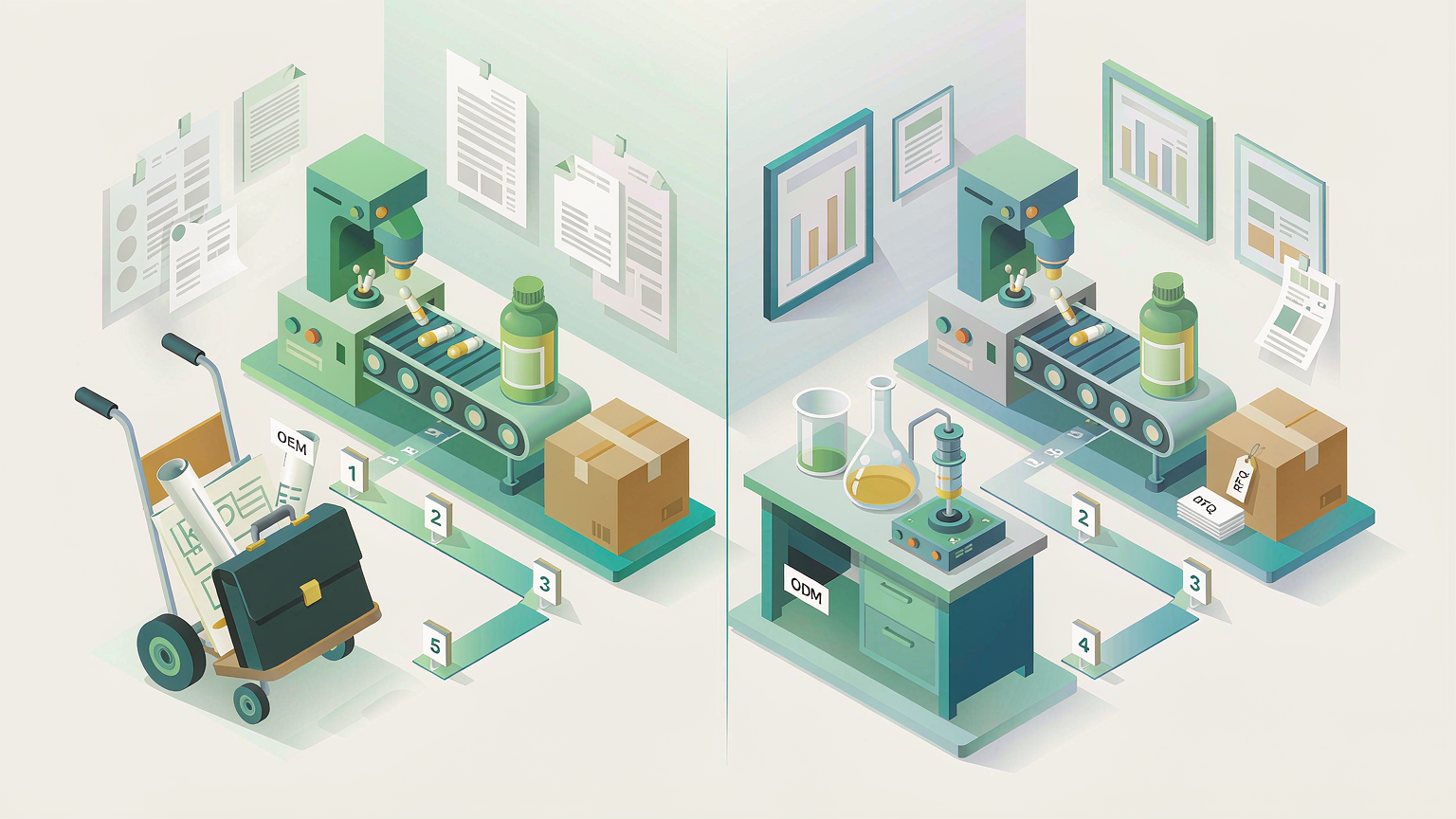
OEM and ODM describe different project structures, but suppliers may use the terms differently. In a typical OEM project, the customer brings a defined product concept, formula, specification, packaging direction, or brand brief. In a typical ODM project, the partner may contribute more to ingredient selection, formula development, product configuration, prototypes, and technical design.
Neither label defines the complete service. The written project brief should state development stages, product category, specification, quality documents, packaging, label responsibility, ownership, confidentiality, target market, and exclusions.
Key Takeaways
- Define the requested scope instead of relying on the word OEM or ODM.
- Separate raw-material supply, formulation, pilot work, packaging, and commercial production.
- Agree who owns the formula, artwork, test data, and technical file.
- Define who reviews product claims, label content, and target-market requirements.
- Do not treat a sample, pilot batch, or service discussion as a commercial supply commitment.
1. Start With the Customer’s Product Brief
Before requesting a quotation, define the product format, ingredient list, target audience, packaging, volume, quality documents, desired market, and claims direction. State what is fixed and what remains open for development.
A useful brief includes:
This allows a supplier to determine whether the request is for raw-material supply, blending, formula development, packaging coordination, finished-product manufacturing, or a combination.
2. What OEM May Include
An OEM project may include production against a customer-defined formula or specification. Depending on the supplier, the scope may cover ingredient procurement, blending, filling, packaging, batch documents, sample coordination, and logistics support.
The customer may remain responsible for formula ownership, label content, brand claims, artwork, market review, and final approval. These responsibilities should be documented rather than assumed.
An OEM project can still require technical discussion. The supplier may need to confirm raw-material availability, production feasibility, test methods, packaging compatibility, minimum quantity, and change-control requirements.
3. What ODM May Include
An ODM project may include product concept development, ingredient selection, formula direction, prototype work, flavor or texture discussion, packaging options, and pilot production. The partner may provide technical suggestions based on available ingredients and manufacturing capabilities.
ODM does not transfer every decision to the supplier. The customer still needs to review the final formula, label, intended use, quality documents, intellectual property, and target-market requirements. The development scope should state which decisions are advisory and which are contracted deliverables.
4. Separate the Project Stages
Use clear stage names in the project brief:
| Stage | Main purpose | Typical questions |
| R&D sample | Explore feasibility or taste | What can be tested? |
| Prototype | Review a proposed direction | What should change? |
| Pilot batch | Test a larger process | Does the process scale? |
| Scale-up review | Confirm process and documents | What must be controlled? |
| Commercial supply | Produce approved product | What is the release process? |
Each stage can have different quantities, equipment, packaging, testing, lead-time assumptions, and approval steps. A sample result does not automatically establish commercial-batch performance.
5. Define Quality and Documentation
The project should identify the required specification, COA, SDS, TDS, allergen statement, origin information, testing records, packaging details, storage, shelf life, traceability, and change-notification process.
For botanical extracts, define identity, plant part, marker compounds, contaminants, and testing methods. For liposomal ingredients, define active content, particle size, dispersibility, stability, packaging, and test conditions. For sports nutrition materials, define composition, grade, batch testing, allergen information, and intended use.
If the final product is marketed in the United States, the customer should define who reviews product category, label, claims, and target-market requirements. Documentation support does not automatically mean that the supplier assumes every market-review responsibility.
6. Clarify Responsibilities With a RACI-Style Table
| Work item | Customer | Supplier | Confirm in writing |
| Raw-material approval | May approve target | Provides documents and samples | Product code and release criteria |
| Formula direction | Defines brand goal | May provide technical input | Ownership and change process |
| Testing | Reviews requirements | Performs or coordinates agreed tests | Method and acceptance limits |
| Label language | Owns brand direction | Provides technical inputs | Final reviewer |
| Packaging artwork | Usually supplies artwork | May coordinate production | File ownership and approval |
| Batch release | Approves final use | Releases against specification | Sign-off process |
| Complaints | Receives market feedback | Investigates agreed scope | Response timing and records |
| Change control | Reviews customer impact | Notifies agreed changes | Notification period |
| Export documents | Defines destination needs | Provides agreed documents | Responsible party |
| Market review | Owns final market decision | Supports documents if agreed | Scope and exclusions |
The table is a starting point, not a contract. The actual agreement should match the project.
7. Address Confidentiality and Intellectual Property
Discuss confidentiality before sharing proprietary formulas, customer information, product concepts, or supplier lists. Define whether the formula is customer-owned, supplier-owned, jointly developed, or licensed for a specific project.
Also discuss sample retention, data access, artwork ownership, use of trademarks, technical data access, and whether a similar formula may be offered to other customers. The agreement should distinguish pre-existing technology from project-specific development.
8. Define Packaging and Label Responsibility
Packaging is often treated as a simple production step, but it can affect product protection, storage, shipping, shelf life, label content, and documentation. Confirm the container, closure, liner, fill weight, label file, artwork approval, language, lot coding, expiry or retest information, and shipping case.
The buyer should also confirm who owns the final label review and which technical fields must appear on the package. Packaging coordination does not automatically mean that every label or claim has been reviewed for the target market.
9. Separate Commercial Goals From Service Scope
An OEM or ODM supplier can describe its services, documents, production stages, and communication process. A service page should not promise sales, margin, approval, launch timing, customer growth, or a particular market result.
Those outcomes depend on formula, label, product quality, pricing, distribution, market conditions, customer execution, and applicable review. A well-defined service scope is more useful than a broad promise.
10. Use an RFQ Checklist
Before requesting an OEM or ODM quote, prepare:
This allows suppliers to distinguish a simple bulk-ingredient inquiry from a full formulation project.
11. Common Project Risks
Undefined scope
“Full service” can mean different things. List every intended deliverable and every exclusion.
Confused ownership
Formula ownership, technical data, artwork, trademarks, and testing results should be addressed before development begins.
Sample-to-bulk mismatch
A sample may use a different batch, packaging, equipment, or process from commercial supply. Define how continuity will be evaluated.
Unclear market responsibility
The supplier may provide documents without taking responsibility for the customer’s final label, claims, or market decision.
Uncontrolled changes
Formula, raw material, facility, packaging, or test-method changes should follow a written notification and approval process.
12. Compare Quotations by Deliverable, Not Only Price
A useful quotation separates development charges, sample charges, raw-material costs, testing, packaging, artwork, documentation, logistics, and recurring production costs. It should state what is included, what is optional, what is charged at cost, and what depends on a final technical assessment.
Ask whether the quoted amount assumes a standard formula, a custom formula, a defined raw-material grade, a particular package, a minimum order, or a specific shipping route. Two quotations can look different while covering different work. Comparing line items makes the commercial discussion more transparent.
13. Create a Project-Gate Review
Use project gates before moving to the next stage:
Each gate should have an owner, required documents, open questions, and a written decision. This helps prevent a sample discussion from being treated as approval for a commercial order.
14. Prepare for Ongoing Supply
After the first order, the buyer should continue to review batch documents, changes, complaints, packaging, storage, and delivery records. Agree how a raw-material substitution, facility change, test-method change, or packaging change will be communicated.
An OEM/ODM relationship is easier to manage when the same product code, specification, ownership record, and change-control process are used across samples, pilot work, and commercial supply.
Common Questions
Is OEM less customized than ODM?
Not necessarily. The terms vary between suppliers. Review the actual formula, development, packaging, testing, documentation, and ownership scope in the project documents.
Who owns an ODM formula?
Ownership depends on the agreement. Discuss development work, pre-existing technology, customization, licensing, confidentiality, and future use before the project begins.
What should a buyer provide for an OEM or ODM discussion?
Provide the product format, ingredients, target application, packaging, volume, quality documents, target market, claims direction, and desired development stage.
Does a pilot batch equal commercial supply?
No. A pilot batch may use different quantities, equipment, packaging, and testing conditions. Commercial supply requires its own specification and release process.
Does an OEM or ODM service include market review?
It may include documentation support, but the exact scope must be confirmed. The customer and appropriate professionals should review product category, label, claims, and target-market requirements.
How should a buyer compare two OEM/ODM quotations?
Compare deliverables, raw materials, testing, documents, packaging, minimum quantities, change control, ownership, confidentiality, logistics, exclusions, and approval responsibilities. Do not compare only the unit price.
What is the difference between an R&D sample and a pilot batch?
An R&D sample explores a concept or formula direction. A pilot batch evaluates a larger or more production-relevant process. The exact definition should be agreed in the project brief.
What documents should be requested before commercial supply?
Request the approved specification, current COA process, applicable SDS/TDS, packaging details, traceability, batch release procedure, change-control process, and agreed shipping documents.
Discuss an OEM/ODM Project
Send a product brief with intended use, formula status, target market, volume, packaging, documentation needs, confidentiality requirements, and desired project stage for an initial scope discussion.