How Moisture Content, Particle Size, and Bulk Density Affect Botanical Powder Handling
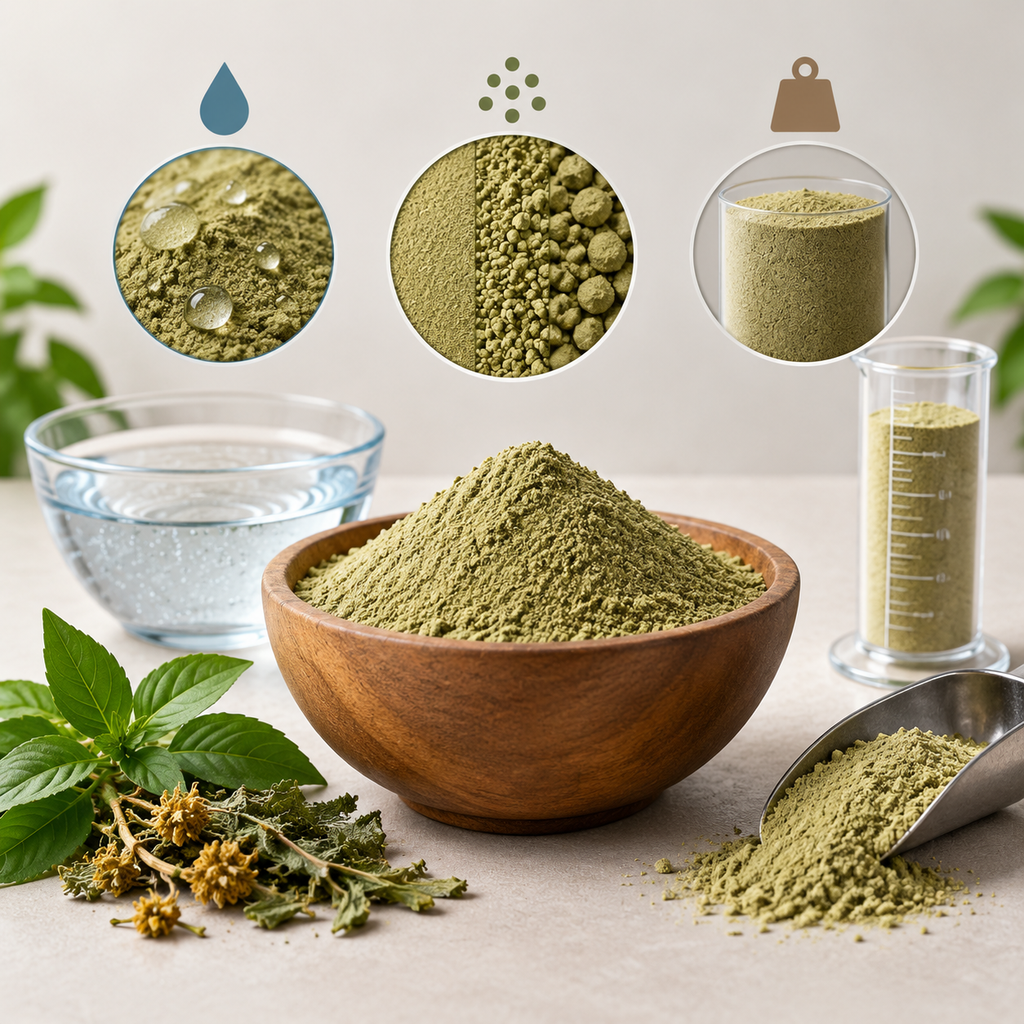
Moisture content, particle size distribution, and bulk density are the three physical parameters that most often explain botanical powder handling problems. Moisture changes flow, clumping, and storage stability; particle size controls segregation, mixing uniformity, dusting, and dissolution behavior; bulk density affects fill weight, capsule volume, pouch sizing, and shipping cube. For purchasing and scale-up, treat these attributes as specification items, not afterthoughts. Confirm test methods, acceptable ranges, sampling plans, and change notification expectations before approving botanical powder for production.
Why powder handling attributes matter in B2B ingredient sourcing
Botanical extracts and functional nutritional ingredients are often purchased against identity, assay, contaminant, and microbiological criteria. Those are essential, but they do not fully predict how a powder will behave in dispensing, blending, sieving, encapsulation, tableting, stick-pack filling, pouching, or drum discharge. A botanical powder can meet its chemical specification and still bridge in a hopper, segregate in a blender, dust during charging, or underfill a capsule because its physical attributes were not defined tightly enough.
For production engineers, formulation teams, and QA professionals, botanical powder handling is therefore a cross-functional topic. Procurement may focus on consistency between lots. Quality may need documented test methods. R&D may need predictable blend uniformity. Manufacturing may need a powder that feeds within the normal equipment window. These needs overlap, but they are not identical.
Shaanxi Bolin Biotechnology Co., Ltd. publicly lists botanical extracts and functional ingredient categories on its product catalog, and its contact page describes product consultation, samples, formulation support, and OEM/ODM inquiries. Those resources can support buyer discussions, but any physical handling requirement should still be documented in the buyer’s own purchase specification and quality agreement. This article discusses procurement and documentation topics only; it does not establish product approval status, market suitability, or health outcomes.
Moisture content changes flow, clumping, and storage behavior
Moisture content is one of the first parameters to check when a botanical powder becomes sticky, slow-flowing, or inconsistent during filling. Plant-derived powders commonly contain natural sugars, fibers, polysaccharides, proteins, organic acids, pigments, and other constituents that may interact with water. Some powders are more hygroscopic than others, meaning they tend to absorb moisture from humid air during storage or processing.
This is a common reason why botanical powder clumps. Moisture can form liquid bridges between particles. As powder rests under pressure in a bag, fiber drum, hopper, or tote, those bridges may become stronger, producing lumps, caking, or poor discharge. In some materials, moisture can also increase wall friction, making the powder adhere to equipment surfaces. In other cases, excess dryness may increase static charge and dusting, so “lower moisture” is not automatically better for every application.
Moisture also affects stability. Higher moisture can create conditions that are less desirable for maintaining physical quality during storage, especially when combined with heat, compression, or repeated exposure to humid air. Buyers should distinguish between several related measurements:
- Loss on drying: a commonly documented method that measures weight loss under defined drying conditions. It may include water and other volatile components.
- Water content: a more specific measurement when a method such as Karl Fischer titration is applicable.
- Water activity: a measure of available water, often useful for assessing microbial and stability-related risk in foods and dietary supplement ingredients.
Which parameter belongs in the purchase specification depends on the material, formulation, and regulatory category. Buyers should confirm with their own regulatory counsel and quality teams which tests are required for the intended market and finished product type.
Particle size distribution affects blending, dusting, and segregation
Particle size distribution is not just a single mesh number. It describes how much of the powder falls into different size ranges. Two powders can both be described as “fine powder” while behaving very differently if one has a narrow distribution and the other contains a mixture of fines and coarse particles.
For formulators asking how particle size affects mixing, the key issue is compatibility with other ingredients in the blend. Powders with similar particle size, density, and shape typically mix more predictably. When one component is much finer or denser than others, it may migrate during vibration, transfer, or hopper feeding. That movement can create segregation, which may reduce blend uniformity even after an acceptable mixing step.
Fine particles can improve dispersion in some systems, but they can also increase dust generation, electrostatic behavior, and operator exposure concerns. Coarser particles may flow better in some feeders, yet they can separate from fine excipients or create visual speckling in blends. A broad distribution can sometimes improve packing and flow, but it may also mask a high level of fines that create dust or caking issues.
For botanical powders, particle shape also matters. Many plant-derived powders are not perfect spheres. Fibrous, flaky, porous, or irregular particles can interlock, resist flow, or trap air. Because of that, a particle size specification should be tied to a defined method, such as sieve analysis or laser diffraction, rather than a vague description alone. If the method changes, the result may change even when the powder itself has not.
Bulk density affects capsule filling and packaging volume
Bulk density describes the mass of powder occupying a given volume. It is typically reported as loose bulk density and tapped bulk density. Loose bulk density reflects how the powder occupies space after gentle filling. Tapped bulk density reflects the volume after controlled tapping or settling. The relationship between the two can help indicate compressibility and flow tendency.
The connection between bulk density and capsule filling is direct. Capsules have limited internal volume. If a powder has low bulk density, the target fill weight may not fit in the selected capsule size without densification, granulation, or formula adjustment. If density varies between lots, a filling machine set up for one lot may produce different fill weights or require frequent adjustments for another.
Bulk density also affects packaging volume. A low-density powder may require larger bags, drums, cartons, or finished product containers for the same net weight. A high-density powder may settle more during transportation, changing headspace appearance in pouches or jars. Neither low nor high density is automatically better. The practical question is whether the density is suitable and consistent for the buyer’s equipment, fill format, and package presentation.
In procurement, bulk density should be discussed early when the ingredient will be used at a high inclusion level, filled into capsules, packed into sachets or sticks, or transferred through volumetric feeders. A powder that performs well in small laboratory scoops may still create problems in an automated line if its density, aeration, or compressibility is not within the expected range.
Parameter-purpose table for purchase specifications
| Parameter | What it helps control | Common documentation approach | Buyer notes |
|---|---|---|---|
| Moisture content, loss on drying, or water activity | Flow, clumping, caking tendency, and storage behavior | Defined test method, acceptance range, and sampling point | Confirm whether the value measures water specifically or total volatile loss. |
| Particle size distribution | Mixing uniformity, segregation risk, mouthfeel where relevant, dusting, and dissolution behavior | Sieve analysis, laser diffraction, or another agreed method | Avoid vague terms such as “fine” unless supported by measurable limits. |
| Loose and tapped bulk density | Capsule filling, package sizing, feeder settings, and shipping cube | Compendial or internally validated density method, as applicable | Ask whether density is measured after milling, blending, or final packing. |
| Flowability indicators | Hopper discharge, bridging, ratholing, and filling consistency | Angle of repose, Carr index, Hausner ratio, shear testing, or plant trial data | Select tests that reflect the buyer’s actual equipment risk. |
How the three parameters interact during scale-up
Moisture, particle size, and bulk density should not be evaluated in isolation. They interact during milling, drying, sieving, blending, storage, and transport. For example, a finer particle size may increase surface area and make the powder more sensitive to humidity. A powder that absorbs moisture may become denser after settling or form agglomerates that change its apparent particle size. A density shift may alter feeder output even if the chemical assay remains unchanged.
Scale-up can reveal these interactions quickly. In a laboratory, a technician may manually break soft agglomerates, scoop powder slowly, or blend small quantities with limited transfer. In production, the same powder may be poured from bags, conveyed, exposed to plant humidity, held in a hopper, compressed by its own weight, and dosed at speed. Each step can amplify a physical property that was not obvious during bench work.
For that reason, buyers commonly request representative samples before first purchase approval. Sample evaluation may include visual inspection, sieve checks, density measurement, blend trials, capsule or sachet filling trials, and storage under controlled internal conditions. The public contact page for Bolin describes samples and formulation support as inquiry topics, but specific evaluation requirements should be defined by the buyer and confirmed in writing with the supplier.
What to include in a botanical powder handling specification
A useful purchase specification should combine quality requirements with process-relevant physical attributes. The goal is not to over-specify every possible parameter. The goal is to identify the properties that, if changed, would create risk in the buyer’s process.
For many botanical powders, buyers should consider documenting:
- Material name and grade description: including extract ratio or marker information only when supported by the agreed product documentation.
- Moisture-related limits: such as loss on drying, water content, or water activity, with a defined test method.
- Particle size distribution: including mesh limits or percentage retained/passed, where relevant.
- Bulk density range: loose and tapped values when filling, packaging volume, or feeder behavior is important.
- Appearance and sensory-neutral physical descriptors: such as color range, odor description, and visible foreign matter criteria, without implying health effects.
- Packaging configuration: inner liner, closure type, and pack size if these affect moisture protection or handling.
- Storage and handling instructions: typically based on the supplier’s product documentation and the buyer’s internal procedures.
- Change notification expectations: covering milling method, sieve target, drying process, carrier or excipient changes, and packaging changes where applicable.
Specifications should also state which documents are required with each lot. These may include a certificate of analysis, allergen statement, non-GMO statement, contaminant test information, or other documents depending on the buyer’s market and product category. Buyers should confirm with their own regulatory counsel before relying on any document for market access, label claims, or product registration decisions.
How to troubleshoot common handling failures
When a powder problem appears in production, start by locating where the failure occurs. A clump found when opening a bag suggests storage, moisture pickup, compression, or packaging protection issues. Bridging in a hopper may indicate poor flowability, high cohesion, unfavorable particle shape, or equipment geometry. Poor blend uniformity may point to particle size mismatch, density mismatch, insufficient mixing, overmixing, or segregation during discharge. Inconsistent capsule weights may involve bulk density variation, powder aeration, feeder settings, or environmental humidity.
A practical troubleshooting sequence is:
- Retain and compare samples: compare the problem lot with an approved retained lot under the same test conditions.
- Check moisture first: measure the agreed moisture parameter and review storage exposure after receipt.
- Measure particle size distribution: look for excess fines, oversized particles, or agglomerates.
- Measure loose and tapped density: compare against previous lots and production setup records.
- Review packaging integrity: inspect liners, seals, closures, and pallet conditions.
- Review process changes: check whether milling, sieving, blending, or drying conditions changed at either party.
For recurring issues, a buyer may need to add a more specific physical